
It was a compromise between having Congress elect the president and a direct election by popular vote.
Americans actually vote for the electors who then vote for president when they convene after the election. Electors are chosen in processes defined by state law, creating a patchwork of selection processes.
Each state gets a number of electors equal to its number of members in the U.S. House of Representatives plus one for each of its two U.S. Senators.
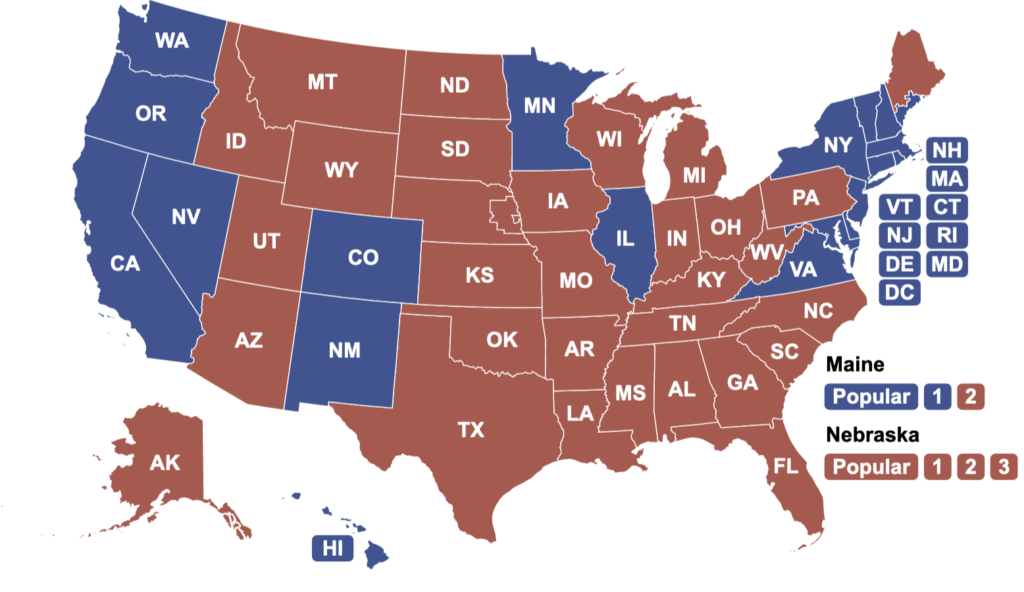
While most states award their electoral votes based on the winner of the popular vote in the state, there are two states which split their electors according to the vote in each congressional district.
The electoral map depicts which political party won which state in the presidential election.
Over the years, red and blue states have come to mean Republican and Democratic states, respectively.
The term “electoral college” actually does not appear in the U.S. Constitution and was derived from the concept of electors used by the Roman empire.
However, in the early 1800’s the term “electoral college” came into general usage as the unofficial designation for the group of citizens selected to cast votes for President and Vice President.
It was later written into Federal law in 1845.
There have been many attempts to reform the Electoral College over the years, but those efforts have typically fallen short.
One notable exception was the 12th Amendment’s separation of electoral votes for president and vice president.
A more promising reform effort in recent years is the National Popular Vote Interstate Compact which takes a state-by-state approach to electoral reform that is distinct from the long history of attempts to amend the U.S. Constitution.
States that sign on to the compact promise to award their electoral votes to whichever candidate wins the popular vote nationally, regardless of which way their state votes.
Examples of “Electoral College” in a sentence:
NPR (January 6, 2001): “Today, a special joint session of the US Congress was held to certify the electoral college votes for President and Vice President.”
Fox News (March 20, 2019): “Every vote matters,' the U.S. senator from Massachusetts told CNN, 'and the way we can make that happen is that we can have national voting, and that means get rid of the Electoral College.”
Yahoo News (December 15, 2020): “The members of the Electoral College on Monday cast their votes to affirm Joe Biden’s win in the 2020 presidential election, delivering a decisive blow to President Trump’s attempt to overturn the result.”